Choosing the right personalized promotional products involves more than adding your company logo to merchandise. The materials, customization method, artwork quality, and logo placement all influence how the finished product represents your business.
Whether you're preparing corporate gifts, employee merchandise, or branded giveaways, understanding the personalization process can help you select products that match your marketing goals and budget.
This guide explains how to choose suitable merchandise, compare customization methods, prepare artwork, and avoid common ordering mistakes.
What Are Personalized Promotional Products?
Custom-branded merchandise includes items featuring a company logo, business name, marketing message, or individual design. Depending on the product, personalization may also include recipient names, employee titles, or unique messages.
Common examples include engraved drinkware, embroidered apparel, printed notebooks, customized bags, and branded office supplies.
While branded merchandise generally displays a company's identity, personalized products may include additional details intended for specific recipients.
For example, a company might distribute tumblers displaying its logo at a conference or order individually engraved bottles as employee recognition gifts.
Understanding the difference can help you choose customization options that match your campaign's purpose.
Why Personalization Matters for Your Business
Personalization helps businesses create merchandise that reflects their brand identity and feels appropriate for the intended audience.
Create Consistent Brand Recognition
Using consistent logos, colors, and messaging across promotional merchandise can help customers recognize your business.
Your branding should remain recognizable whether it appears on a notebook, embroidered shirt, or engraved tumbler.
However, different materials and decoration methods may require adjustments to preserve readability and visual consistency.
Make Corporate Gifts More Meaningful
Adding individual names or thoughtful messages can make promotional merchandise feel more personal.
For example, an employee appreciation gift might feature the recipient's name alongside the company logo. A client recognition gift could include a short message that reflects the business relationship.
Before selecting personalized details, consider whether the product has enough space to display them clearly.
Support Different Marketing Campaigns
Personalized merchandise can serve different purposes depending on the campaign.
Businesses may use customized products for employee onboarding, customer appreciation, corporate events, promotional campaigns, or business partnerships.
The appropriate level of personalization depends on the number of recipients, available budget, product specifications, and desired presentation.
How to Choose Products Based on Personalization Options
Different promotional products support different decoration methods. Rather than selecting merchandise based only on appearance, consider how your logo or design will be applied.
Drinkware for Engraving and Printing
Water bottles, tumblers, mugs, and travel cups can accommodate different customization methods depending on their materials and finishes.
Some stainless steel products are suitable for laser engraving, while certain plastic or coated drinkware products support printed designs.
Before choosing customized drinkware, review the available imprint area, product shape, decoration options, and artwork requirements.
Apparel for Embroidery and Printed Designs
Branded shirts, jackets, polo shirts, and caps provide opportunities for embroidered or printed logos.
Embroidery may suit simple designs on compatible fabrics, while certain printing methods can reproduce larger or more detailed graphics.
Consider how the decoration will appear on different garment sizes and materials.
Office Supplies for Detailed Branding
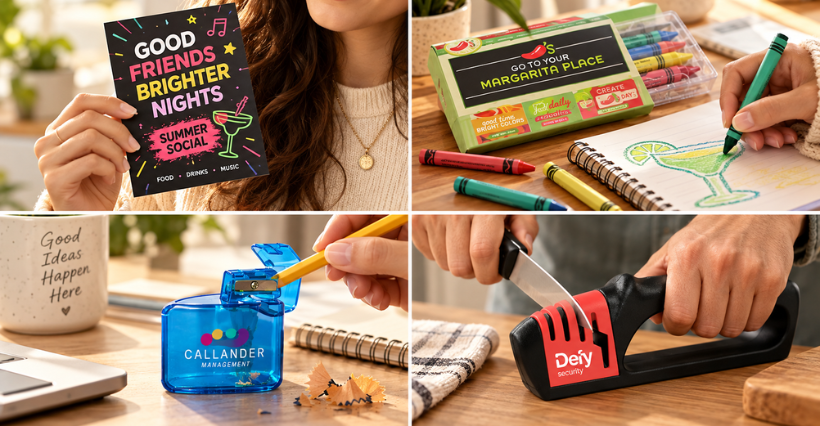
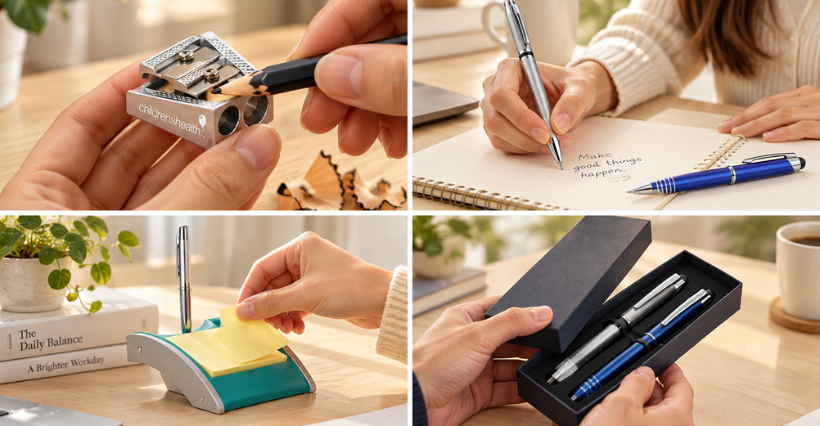
Notebooks, pens, folders, and desk accessories offer different spaces for company logos and promotional messages.
A notebook cover may accommodate a larger design, while a pen generally requires a smaller, simplified logo.
Check imprint dimensions and the available customization methods before submitting artwork.
Bags and Accessories for Larger Designs
Tote bags, backpacks, and travel organizers may provide larger surfaces for printed or embroidered branding.
The material, seams, pockets, and available decoration area can affect where a logo can be placed.
Choose a design that remains visible without interfering with the product's intended use.
Customization Options for Promotional Merchandise
The most suitable personalization method depends on the product material, logo complexity, desired appearance, and budget.
Screen Printing and Pad Printing
Screen printing is commonly used for apparel, bags, and other compatible surfaces. It can be suitable for designs with defined colors and larger imprint areas.
Pad printing is often used for smaller products or surfaces that require specialized decoration.
Both methods have specific artwork and production requirements. Confirm available colors, imprint dimensions, and setup charges with your supplier.
Embroidery and Engraving
Embroidery uses thread to reproduce logos or designs on suitable fabrics. It can provide a textured appearance on clothing, caps, and certain bags.
Laser engraving creates marks on compatible materials, including certain metals and wood products.
These methods may be appropriate when businesses want a more understated appearance or durable branding.
Full-Color Printing
Full-color printing can reproduce multicolored artwork, gradients, and detailed graphics on compatible products, gradients, or detailed graphics.
Available printing methods depend on the product material and surface.
Before ordering, confirm whether the selected product supports your design's colors, dimensions, and placement requirements.
How to Choose the Right Logo Placement and Design
Logo placement can affect the appearance and readability of personalized merchandise. A design that looks clear on a computer screen may not translate well to a small or curved product surface.
Consider the Available Imprint Area
Each product has its own available imprint area and decoration specifications.
A large logo may work well on a tote bag or notebook cover but become difficult to read on a pen or compact accessory.
Check the manufacturer's imprint specifications before finalizing the design.
Keep Your Logo Readable
Complex artwork may require adjustments when applied to smaller merchandise.
Thin lines, tiny lettering, and closely spaced details can become difficult to reproduce through certain printing or embroidery methods.
If necessary, prepare a simplified version of your logo for products with limited decoration space.
Maintain Consistent Brand Colors
Brand colors help create a recognizable appearance across merchandise.
However, printing processes, product materials, and background colors can affect how those colors appear.
Review available color-matching options and confirm any limitations before approving production.
Avoid Overcrowded Designs
Including too much text can make promotional merchandise look cluttered.
Prioritize the most important information, such as your company logo or a short marketing message.
Contact details and website addresses should only be included when the available space allows them to remain readable.
How to Prepare Artwork for Personalized Merchandise
Preparing suitable artwork is an important step in ordering customized promotional products.
Incomplete files, incorrect dimensions, or unclear designs can delay production or lead to unwanted results.
Use Appropriate Artwork Files
Vector files such as AI, EPS, and SVG are commonly used for scalable logo artwork.
Some suppliers may also accept high-resolution PNG, PDF, or other supported formats, depending on the decoration method.
Confirm the required format and resolution before submitting your design.
Check Logo Dimensions and Proportions
Avoid stretching or distorting your logo to fill an imprint area.
Instead, adjust the design proportionally and ensure it fits within the available decoration dimensions.
If necessary, ask whether the artwork can be resized or simplified without affecting its overall appearance.
Review the Artwork Proof
A digital artwork proof may show how your logo or message will appear on the selected merchandise.
Before approving the proof, carefully check:
-
Company name and spelling
-
Logo proportions and positioning
-
Print colors and design details
-
Contact information, when included
-
Individual names or personalized messages
-
Imprint dimensions and orientation
Do not assume that a supplier will automatically identify every spelling or design error.
Confirm Approval Requirements
Some orders require artwork approval before production begins.
Review the supplier's approval process and confirm whether revisions may affect production schedules or additional charges.
Approving the correct artwork can help prevent avoidable mistakes across a larger merchandise order.
How Customization Choices Affect Pricing
The cost of personalized promotional products depends on the merchandise, decoration requirements, order quantity, and delivery arrangements.
Customization costs vary depending on whether the product requires simple logo printing, embroidery, engraving, or individual name personalization.
Factors That Can Influence Customization Costs
Decoration method: Printing, embroidery, and engraving may involve different production requirements and costs.
Number of colors: Certain printing processes charge differently depending on the number of colors used.
Imprint locations: Adding a logo to multiple areas of a product may increase the total decoration cost.
Individual personalization: Unique names or messages may require additional production steps.
Order quantity: Some products offer lower unit prices for larger orders.
Artwork preparation: Design adjustments, digitization, or production setup may involve additional charges.
Packaging and shipping: Custom packaging, split shipments, and expedited delivery can affect the final price.
When comparing quotations, request complete pricing information rather than relying only on the advertised product price.
How to Order Personalized Promotional Products
A clear ordering process helps businesses manage customization requirements, production schedules, and expenses.
Follow these practical steps:
-
Identify your customization needs. Decide whether your merchandise requires a company logo, individual names, marketing messages, or other design elements.
-
Choose compatible products. Review materials, imprint dimensions, available decoration methods, and minimum order requirements.
-
Prepare your artwork. Submit the logo or design in the supplier's preferred file format.
-
Request a detailed quotation. Confirm product pricing, decoration charges, setup fees, quantities, and delivery costs.
-
Review the artwork proof. Check spelling, colors, dimensions, and placement before authorizing production.
-
Confirm production and shipping. Verify estimated completion dates and delivery arrangements before finalizing your order.
For orders needed by a specific event date, confirm product availability and production requirements as early as possible.
Preparing Artwork for a Custom Merchandise Order
Suppose a business wants to order personalized stainless steel tumblers as employee recognition gifts.
The company plans to include its logo and each recipient's name.
Before placing the order, the organizer checks whether the selected tumblers support individual engraving, reviews the available decoration area, and prepares the required artwork files.
The organizer also confirms whether each personalized name requires a separate setup or additional charge.
After receiving the artwork proof, the company checks the spelling of each name, verifies the logo placement, and confirms the production schedule.
This hypothetical example shows why reviewing personalization requirements before ordering can help businesses avoid unnecessary corrections and unexpected expenses.
Common Personalization Mistakes to Avoid
Even suitable merchandise can produce disappointing results when customization details are overlooked.
Common mistakes include:
-
Submitting low-resolution or unsuitable artwork files.
-
Using logos with details that are too small for the imprint area.
-
Selecting decoration methods that are incompatible with the product material.
-
Overcrowding the design with unnecessary text.
-
Failing to confirm available imprint colors.
-
Approving artwork without reviewing spelling and placement.
-
Overlooking additional charges for individual personalization.
-
Ordering before confirming production and delivery requirements.
Reviewing these details helps businesses maintain consistent branding and reduce avoidable ordering problems.
Frequently Asked Questions
Can I use different names or designs on individual promotional products?
Some products support individual names, unique artwork, or variable designs. Availability depends on the merchandise and customization method. Confirm the personalization options and any additional charges before placing your order.
Can I personalize promotional products with more than one logo?
Some merchandise allows multiple logos or designs, depending on the available imprint areas and decoration methods. Additional printing locations or colors may involve extra charges. Confirm the product's customization options before finalizing your artwork.
Can I customize promotional products with a photograph?
Certain products support full-color or photo-quality printing, depending on the material and decoration process. Check the required image resolution, available print area, and product specifications to determine whether your photograph can be reproduced clearly.
Can the same logo be used on different types of merchandise?
Yes, a company logo can often be adapted for different products, including drinkware, apparel, bags, and office supplies. However, artwork dimensions, materials, and decoration methods vary, so some adjustments may be needed.
Bring Your Brand to Life With Personalized Merchandise
The right personalized promotional products can turn your company logo, message, or unique design into merchandise that represents your brand. Choosing suitable materials, decoration methods, and artwork specifications helps create a finished product that looks professional and serves its intended purpose.
PromotionalProducts.com helps businesses explore customizable merchandise for different branding needs. Based in New York City, the company provides options for businesses looking to personalize products with logos, designs, and promotional messages.
Explore the available customization options and request a quote to find products that bring your branding ideas to life.